Passage Three
Questions 31 to 35 are based on the following passage:
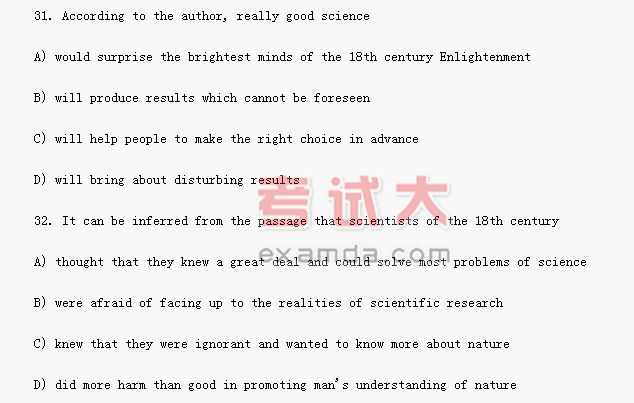
It is hard to predict how science is going to turn out, and if it is really good science it is
impossible to predict. If the things to be found are actually new, they are by definition unknown in
advance. You cannot make choices in this matter. You either have science or you don' t, and if
you have it you are obliged to accept the surprising and disturbing pieces of information, along
with the neat and promptly useful bits.
The only solid piece of scientific truth about which I feel totally confident is that we are
profoundly ignorant about nature. Indeed, I regard this as the major discovery of the past hundred
years of biology. It is, in its way, an illuminating piece of news. It would have amazed the
brightest minds of the 18th century Enlightenment(启蒙运动) to be told by any of us how little we
know and how bewildering seems the way ahead. It is this sudden confrontation with the
depth and scope of ignorance that represents the most significant contribution of the 20th century
science to the human intellect. In earlier times, we either pretended to understand how things
worked or ignored the problem, or simply made up stories to fill the gaps. Now that we have he-
gun exploring in earnest, we are getting glimpses of how huge the questions are, and how far
from being answered. Because of this, we are depressed. It is not so bad being ignorant if you are
totally ignorant; the hard thing is knowing in some detail the reality of ignorance, the worst
spots and here and there the not - so - bad spots, but no true light at the end of the tunnel nor
even any tunnels that can yet be trusted.
But we are making a beginning, and there ought to be some satisfaction. There are
probably no questions we can think up that can' t be answered, sooner or later, including even the
matter of consciousness. To be sure, there may well be questions we can't think up, ever, and
therefore limits to the reach of human intellect, but that is another matter. Within our limits, we
should be able to work our way through to all our answers, if we keep at it long enough, and pay
attention.
33. Which of the following statements is NOT true of scientists in earlier times?
A) They invented false theories to explain things they didn' t understand.
B) They falsely claimed to know all about nature.
C) They did not believe in results from scientific observation.
D) They paid little attention to the problems they didn't understand.
34. What is the author's attitude towards science?
A) He is depressed because of the ignorance of scientists.
B) He is doubtful because of the enormous difficulties confronting it.
C) He is confident though he is aware of the enormous difficulties confronting it.
D) He is delighted because of the illuminating scientific findings.
35. The author believes that
A) man can find solutions to whatever questions concerning nature he can think up
B) man can not solve all the problems he can think up because of the limits of human
intellect
C) sooner or later man can think up all the questions concerning nature and answer them
D) questions concerning consciousness are outside the scope of scientific research
