Passage Three
Questions 31 to 35 are based on the following passage:
While America' s grade - school and high - school system is coming under attack, one fact
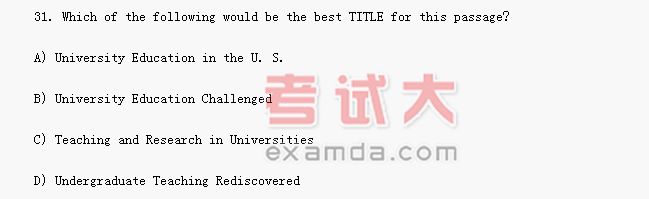
remains: U.S. universities are among the best in the world. Since World War II, American scientists - mostly working in universities or colleges - have won more than half of all Nobel Prizes in physics and medicine. Foreign students rush to the United States by the tens of thousands;last year they earned more than one quarter of the doctoral degrees awarded in the country. Yet while American universities produce great research and great graduate programe, they some-times pay little attention to the task that lies at their very core: the teaching of undergraduate students.
In an era of $ 20,000 academic years, college presidents can no longer afford to ignore the
creeping rot at their core. In speeches and interviews the nation' s higher educators have rediscovered teaching. Robert Rosenzweig, president of the Association of American Universities,
said: "Our organization was never very concerned about teaching. In the last 18 months, we
have spent more time on undergraduate education than on any other subject."
Despite such promising efforts, no one doubts that research still outranks teaching at the
leading universities, not least because it is a surer and faster way to earn status. Some people
don' t think it has to be that way. They argue that the reward system for college faculty can be
changed, so that professors will be encouraged to devote more time and effort to teaching. They
say that they are beginning to believe that the 1990s may come to be remembered as the decade
of the undergraduate.
That would bring 'it full circle. For more than two centuries after the founding of Harvard
College in 1636, the instruction of undergraduate students was an essential condition of American higher education.
32. The first sentence in the second paragraph means that
A) with a budget of $ 20,000, presidents find it difficult to keep their universities going
B) with the increase in fees, educators feel obliged to improve undergraduate teaching
C) with a $ 20,000 budget, presidents find it difficult to stop the creeping rot in their
universities
D) with the decrease in fees, educators can' t afford to lay equal stress on both research
and teaching
33. According to paragraph 3, some people think that the reward system for teachers should be
changed so that
A) more emphasis will be laid on teaching
B) leading universities can further raise their status
C) effort can be directed to graduate instruction
D) the 1990's will become a decade of the-undergraduate
34. According to the passage, at the leading American universities
A) reaearch is declining in importance
B) teaching is now ranked above research
C) teaching is a sure way to gain position
D) more importance is attached to research than to teaching
35. It is implied in the passage that about 150 years ago undergraduate instruction
A) was already threatened by research work
B) began to be neglected in most universities
C) constituted the fundamental part of higher education
D) began to undergo rapid changes
