Passage Three
Questions 31 to 35 are based on the following passage:
War may be a natural expression of biological instincts and drives toward aggression in the human species. Natural impulses of anger, hostility, and territoriality (守卫地盘的天性) are expressed through acts of violence. Theses are all qualities that humans share with animals. Aggression is a kind of innate (天生的) survival mechanism, an instinct for self-preservation, that allows animals to defend themselves from threats to their existence. But, on the other hand, human violence shows evidence of being a learned behavior. In the case of human aggression, violence cannot be simply reduced to an instinct. The many expressions of human violence are always conditioned by social conventions that give shape to aggressive behavior. In human societies violence has a social function: It is a strategy for creating or destroying forms of social order. Religious traditions have taken a leading role in directing the powers of violence. We will look at the ritual and ethical (道德上的) patterns within which human violence has been directed.
The violence within a society is controlled through institutions of law. The more developed a legal system becomes, the more society takes responsibility for the discovery, control, and punishment of violent acts. In most tribal societies the only means to deal with an act of violence is revenge. Each family group may have the responsibility for personally carrying out judgment and punishment upon the person who committed the offense. But in legal systems, the responsibility for revenge becomes depersonalized and diffused. The society assumes the responsibility for protecting individuals from violence. In cases where they cannot be protected, the society is responsible for imposing punishment. In a sate controlled legal system, individuals are removed from the cycles of revenge motivated by acts of violence, and the state assumes responsibility for their protection.
The other side of a state legal apparatus is a state military apparatus. While the one protects the individual from violence, the other sacrifices the individual to violence in the interests of the state. In war the state affirms its supreme power over the individuals within its own borders. War is not simply a trial by combat to settle disputes between states; it is the moment when the state makes its most powerful demands upon its people for their recommitment, allegiance, and supreme sacrifice. Times of war test a community’s deepest religious and ethical commitments.
31. Human violence shows evidence of being a learned behavior in that ______.
A) it threatens the existing social systems
B) it is influenced by society
C) it has roots in religious conflicts
D) it is directed against institutions of law
32. The function of legal systems, according to the passage, is ______.
A) to control violence within a society
B) to protect the world from chaos
C) to free society from the idea of revenge
D) to give the government absolute power
33. What does the author mean by saying “… in legal systems, the responsibility for revenge becomes depersonalized an diffused” (Lines 5-6, Para. 2)
A) Legal systems greatly reduce the possibilities of physical violence.
B) Offenses against individuals are no longer judged on a personal basis.
C) Victims of violence find it more difficult to take revenge.
D) Punishment is not carried out directly by the individuals involved.
34. The word “allegiance” (Line 5, Para. 3) is closest in meaning to ______.
A) loyalty
B) objective
C) survival
D) motive
35. What can we learn from the last paragraph?
A) Governments tend to abuse their supreme power in times of war.
B) In times of war governments may extend their power across national borders.
C) In times of war governments impose high religious and ethical standards on their people.
D) Governments may sacrifice individuals in the interests of the state in times of war.
Passage Four
Questions 36 to 40 are based on the following passage:
Researchers who are unfamiliar with the cultural and ethnic groups they are studying must take extra precautions to shed any biases they bring with them from their own culture. For example, they must make sure they construct measures that are meaningful for each of the cultural or ethnic minority groups being studied.
In conducting research on cultural and ethnic minority issues, investigators distinguish between the emic approach and the etic approach. In the emic approach, the goal is to describe behavior in one culture or ethnic group in terms that are meaningful and important to the people in that culture or ethnic group, without regard to other cultures or ethnic groups. In the etic approach, the goal is to describe behavior so that generalizations can be made across cultures. If researchers construct a questionnaire in an emic fashion, their concern is only that the questions are meaningful to the particular culture or ethnic group being studied. If, however, the researchers construct a questionnaire in an etic fashion, they want to include questions that reflect concepts familiar to all cultures involved.
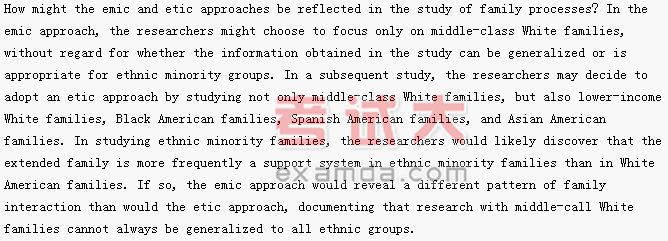
36. According to the first paragraph, researchers unfamiliar with the target cultures are inclined to ______.
A) be overcautious in constructing meaningful measures
B) view them from their own cultural perspective
C) guard against interference from their own culture
D) accept readily what is alien to their own culture
37. 37. What does the author say about the emic approach and the etic approach?
A) They have different research focuses in the study of ethnic issues.
B) The former is biased while the latter is objective.
C) The former concentrates on the study of culture while the latter on family issues.
D) They are both heavily dependent on questionnaires in conducting surveys.
38. Compared with the etic approach, the emic approach is apparently more ______.
A) culturally interactive
B) culture-oriented
C) culturally biased
D) culture-specific
39. The etic approach is concerned with ______.
A) the general characteristics of minority families
B) culture-related concepts of individual ethnic groups
C) features shared by various cultures or ethnic groups
D) the economic conditions of different types of families
40. Which of the following is true of the ethnic minority families in the U.S. according to the passage?
A) Their cultural patterns are usually more adaptable.
B) Their cultural concepts are difficult to comprehend.
C) They don’t interact with each other so much as White families.
D) They have closer family ties than White families.
